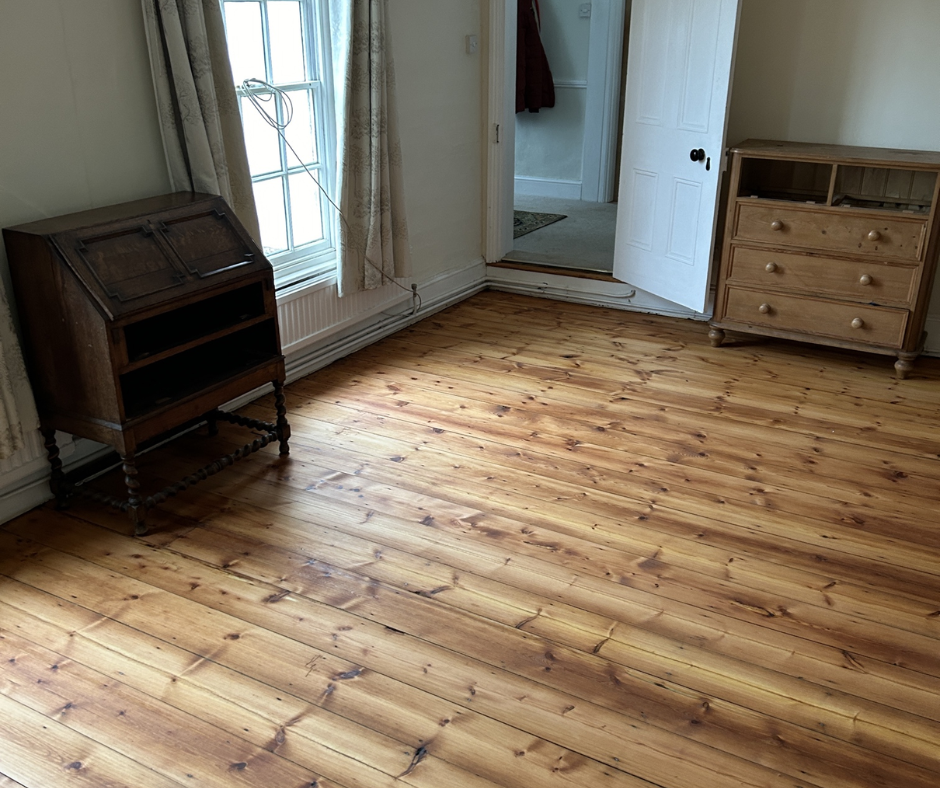
Old pine floorboards, a little TLC and a lovely transformation. Sometimes the floor you’ve already got is worth another look!
There’s something rather special about Lavenham, isn’t there?
The crooked timber-framed buildings, the beautiful old streets and the feeling that some of these places have more stories to tell than your grandparents after a Sunday roast!
It’s a village full of character. And if there’s one thing we love, it’s character.
Especially when it comes to wooden floors.
Our floor restoration team recently completed a pine wood floor restoration in Lavenham, Suffolk, and we’ve got the before-and-after photographs to share.
Now, we’re not saying every old floor can be brought back to life.
But before you decide those tired-looking boards are ready for the skip, it’s worth finding out what can actually be done.
Because sometimes, there’s a lovely wooden floor hiding beneath years of wear.
And wouldn’t it be a shame to give up on it too soon?
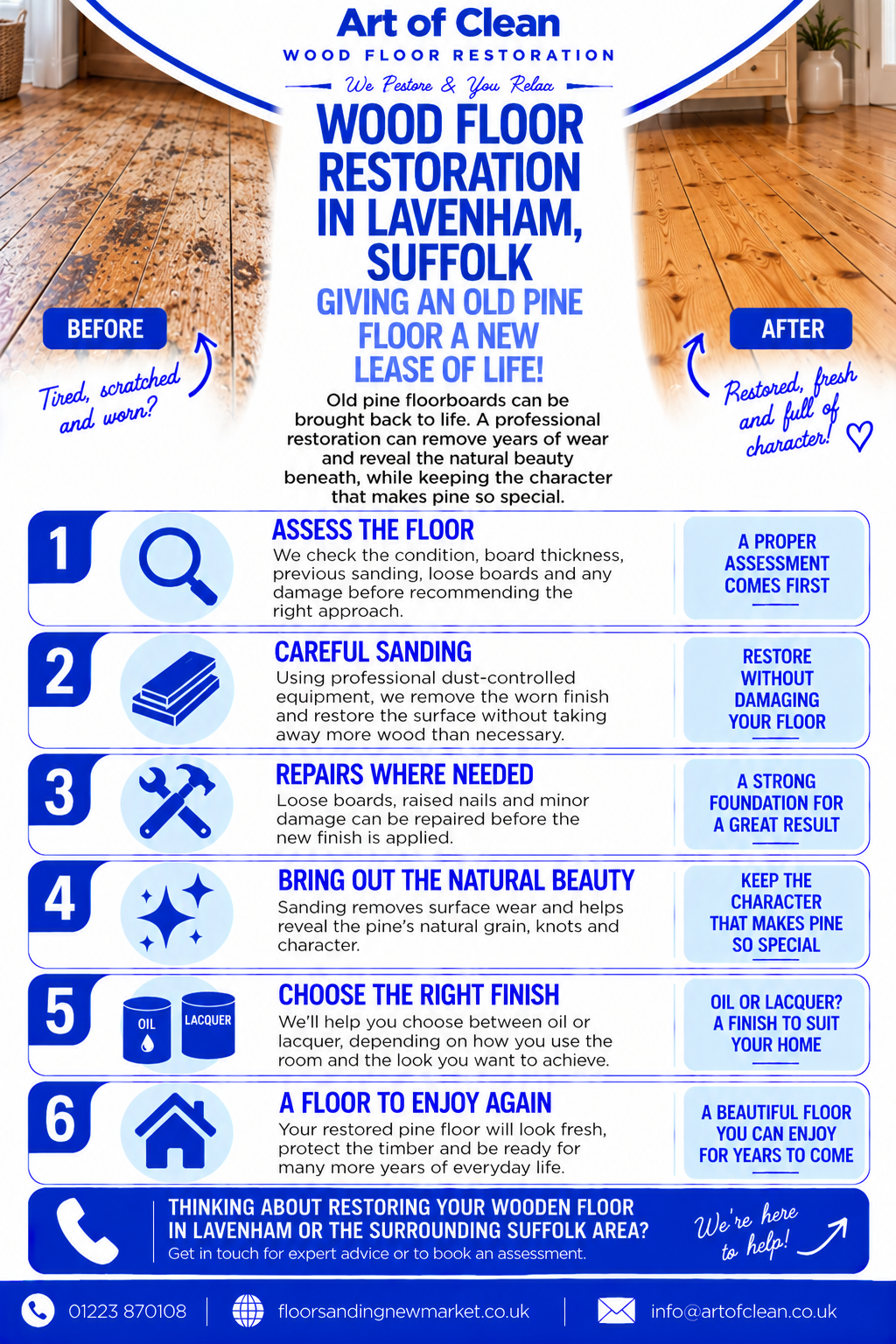
A pine floor restoration right here in Lavenham
We love sharing real jobs because they show what floor restoration actually looks like, rather than just talking about it.
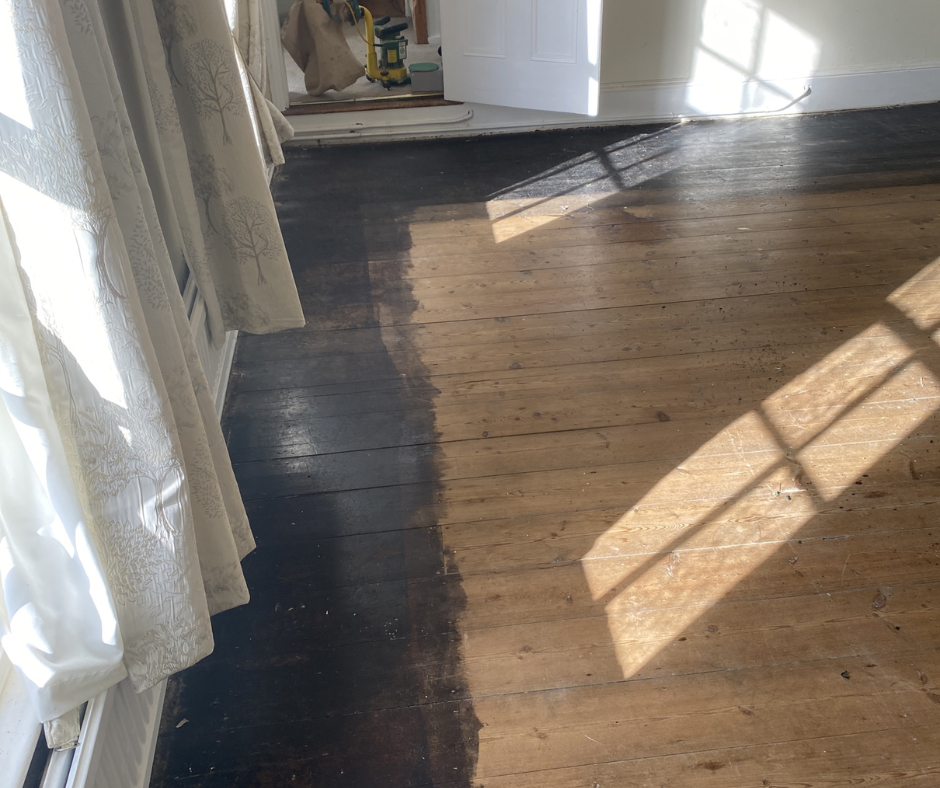
For this project in Lavenham, our team worked on an existing pine wooden floor.
And pine is a lovely material to work with, although it does like to keep us on our toes!
Unlike harder woods such as oak, pine is relatively soft, which means everyday life can leave its mark.
Furniture gets moved. Shoes bring in little bits of grit. Chairs scrape. Things get dropped.
And before you know it, your lovely wooden floor has a few more battle scars than you remember!
But here’s the important thing.
A worn-looking pine floor isn’t necessarily a ruined pine floor.
Depending on the timber’s condition and how much material remains, professional sanding and refinishing may help improve its appearance while keeping the natural character that makes it so appealing.
Our Lavenham project is a lovely opportunity to show exactly why it’s worth assessing a floor before deciding what to do next.
Caption: The pine floor at our Lavenham restoration project before the work.
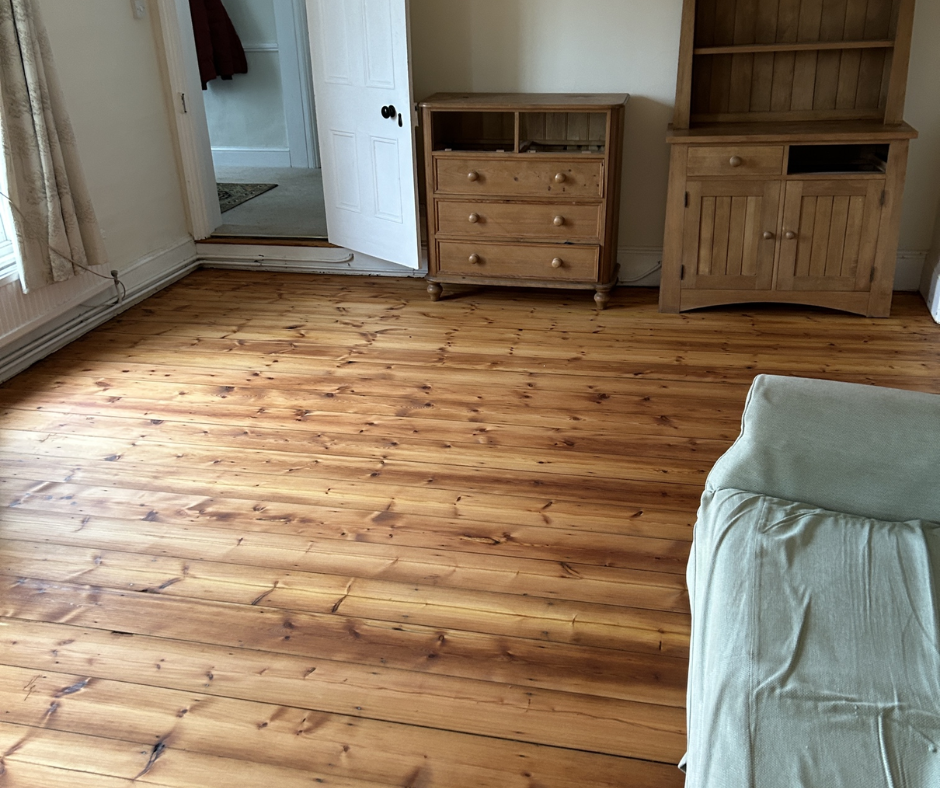
Caption: The same pine floor following restoration. A great example of why existing timber deserves a second look.
Why pine floors have so much character
Pine isn’t perfect. And do you know what? That’s part of its charm!
The knots, grain patterns, and natural colour variations give pine its own personality.
It isn’t supposed to look like a sheet of identical wooden planks that have just rolled off a production line.
Real wood has character, and restoration doesn’t always mean making every mark disappear.
Some dents may be too deep to remove without taking away more wood than is sensible. Older stains can sometimes remain visible, and boards may have natural colour differences.
That’s why we believe good wood floor restoration starts with understanding the floor itself.
What sort of timber is it? Has it been sanded before? Are the boards secure? How much usable wood is left?
These questions aren’t there to make things complicated.
They’re there to help avoid unnecessary work and protect the floor for the future.
Lavenham’s older buildings deserve a little understanding.
One of the things that makes Lavenham so special is its wonderful collection of historic buildings.
According to the National Trust’s history of Lavenham, the village has more than 320 buildings of historic significance, many connected to its wealthy medieval cloth-trading past.
Now, that doesn’t mean every floor in Lavenham is centuries old!
But it does remind us why understanding older building materials matters.
In an older property, a wooden floor may have been repaired, altered or covered over at different points in its life.
Some boards may be original to the building, while others may have been added much later.
And here’s where a little caution comes in.
Just because a floor looks old doesn’t mean it needs aggressive sanding.
If you’re dealing with a particularly historic floor, or a listed building, it’s sensible to check whether conservation advice or consent is needed before carrying out work that could affect historic fabric.
After all, preserving something special is rather difficult once you’ve sanded it away!
Can you sand an old pine floor without damaging it?
Yes, you can sand many pine floors successfully, but the wood’s condition makes all the difference.
Pine is softer than oak, which means sanding needs careful control.
Too much pressure, an unsuitable sanding technique or spending too long in one spot can remove more wood than intended.
And here’s the slightly terrifying part.
Once you’ve sanded wood away, you can’t simply stick it back on!
That’s why we always encourage people to be cautious about hiring a sanding machine before they understand their floor.
A professional will normally consider the condition of the boards, previous sanding, protruding fixings and any repairs needed before beginning.
Remember that some floors have already been sanded several times.
You may have less timber to work with than you think.
The aim should be to improve and protect the floor, not remove every last sign that somebody has ever lived in the house.
Choosing the right finish for a restored pine floor
Here’s where things get interesting!
Once a wooden floor is properly prepared, the finish could make a huge difference in how it looks and how it handles everyday life.
And no, there isn’t one magical finish that’s right for every room.
For example, wood floor sanding and oiling may suit homeowners who prefer a natural-looking finish that brings out the timber’s grain.
Alternatively, wood floor sanding and lacquering may suit those who want a different look or a more protective coating.
Both approaches have their advantages, and each comes with its own maintenance requirements.
The important questions are simple.
How do you use the room? Do you have pets or children? Do you drag dining chairs across the floor every day? Do you prefer a natural appearance or a particular sheen?
Choose a finish for the way you actually live, not just because it looks lovely in a photograph.
And remember that different products can alter the colour of pine. Some bring out warmer tones, while others are designed to make it look lighter.
Testing suitable finishes before you decide can help avoid an unwelcome surprise.
Nobody wants to finish a whole room only to say, “Oh. That’s not quite what I imagined!”
Do all old wooden floors need sanding?
Here’s a little secret.
Sometimes the best advice is don’t sand it!
Yes, really.
Not every dull or tired-looking wooden floor needs a complete restoration.
Sometimes the surface is simply dirty, or the protective finish needs attention.
Depending on the existing coating and its condition, professional cleaning or a suitable maintenance treatment may be enough.
That’s worth exploring, particularly with pine, because every full sanding removes some of the wood.
On the other hand, if the protective finish has worn through, the surface is heavily marked, or the existing coating is failing, sanding and refinishing may be the more appropriate route.
The best decision is the one that suits your actual floor, not the one that involves the biggest job.
Five simple ways to look after your pine floor
Once a pine floor has been restored, a few sensible habits can help keep it looking good.
And thankfully, none of them involves following your family around the house with a dustpan!
- Put felt pads under furniture legs. Dining chairs and heavy furniture can leave marks, especially on softer pine.
- Keep grit under control. Little bits of dirt and sand can act like sandpaper when people walk over them.
- Use the right cleaning products. What works on tiles or laminate may not be suitable for your particular wood finish.
- Avoid excessive water. A damp cleaning method may be suitable for some finishes, but soaking wooden floors is asking for trouble.
- Watch for signs of finish wear. It’s often easier to deal with a coating problem early than leave the timber exposed to further damage.
And please, if you see an unusual mark, don’t immediately reach for vinegar, bleach or the strongest cleaner in the cupboard.
A quick cleaning experiment can sometimes turn a small problem into a much bigger one.
If you’re unsure, asking for advice first could save an expensive mistake.
What can a restored wooden floor really look like?
This is the bit we always enjoy!
Seeing the results of work carried out by our floor restoration team never gets old.
But we also think it’s important to keep expectations realistic.
Restoration can improve a floor’s appearance, prepare it for a suitable new finish and help protect the timber.
It doesn’t necessarily erase every deep dent, old stain, gap or uneven board.
And that’s perfectly fine.
A beautiful wooden floor doesn’t have to be a flawless wooden floor.
Sometimes the little imperfections are exactly what make it feel right for the home.
If you enjoy seeing real examples of different timber floors and finishes, you can explore more of our wood floor restoration case studies.
They offer a useful reminder that every floor needs its own approach.
A lovely pine floor, and a reminder not to give up on existing wood
Our Lavenham pine floor restoration is a great example of the sort of work we enjoy sharing.
Not because we’re trying to persuade everyone to have their floors sanded.
Quite the opposite.
We want people to understand what they’ve already got and how best to look after it.
Because an old wooden floor may still have plenty of life left in it.
Sometimes it needs sanding. Sometimes it needs a different type of care. And sometimes, those little marks are simply part of its story.
Before you cover it, replace it or take a sanding machine to it, find out what your floor actually needs.
And if you’re in Lavenham or elsewhere in Suffolk wondering what to do with your wooden floor, we’re always happy to help you understand your options.
After all, a bit of good advice is much cheaper than having to put right a sanding disaster!
And those lovely old floorboards? They deserve a fighting chance.
Not every tired-looking wooden floor needs a full sand.
If the existing protective finish is still in suitable condition, professional cleaning or a compatible maintenance coat may be enough to improve its appearance.
However, if the finish is badly worn, peeling or exposing the timber underneath, sanding and refinishing might be the more appropriate option.
For homeowners in Lavenham, particularly those with older pine floors, it’s worth getting advice before making that decision.
After all, why remove perfectly good wood if you don’t need to?
Frequently Asked Questions About Restoring Wood Floors in Lavenham, Suffolk
-
Can old pine wooden floors be restored in Lavenham homes?
Absolutely! Many older pine floors can be restored, even when they look tired, scratched, or worn.
Pine is a softer wood, so dents and marks are quite common, especially in busy family homes. But that doesn’t automatically mean you need to replace the floor.
The key is to check the condition of the boards first. If there’s enough usable timber and the floor is structurally sound, careful sanding and refinishing may give it a lovely new lease of life.
And don’t worry if a few old marks remain. Sometimes they’re part of the charm!
-
Will sanding remove all the scratches and stains from my pine floor?
We’d love to say yes, but wooden floors aren’t quite that predictable!
Sanding can remove many surface scratches, worn finishes and some discolouration. However, deep dents, stubborn stains and damage that has penetrated the timber may still be visible afterwards.
And with softer wood like pine, we need to be particularly careful about how much material is removed.
The aim isn’t to sand away every last sign of life. It’s to improve the floor while keeping as much healthy timber as possible.
-
How long does pine floor restoration take in a Lavenham property?
That depends on the size of the floor, its condition, any repairs needed and the finish being applied.
A smaller room may be relatively straightforward, while larger or more complicated floors can take several days, especially when you include preparation, finishing, and drying time.
Remember, the floor may need extra time before you can walk on it normally or move furniture back. That depends on the finishing product and its curing requirements.
It’s always sensible to plan ahead rather than discovering your dining table needs to live in the hallway for longer than expected!
-
Do I need to sand my wooden floor, or could it just be cleaned and refinished?
Now, this is a question we’re always pleased when homeowners ask!
Not every tired-looking wooden floor needs a full sand.
If the existing protective finish is still in suitable condition, professional cleaning or a compatible maintenance coat may be enough to i mprove its appearance.
However, if the finish is badly worn, peeling or exposing the timber underneath, sanding and refinishing might be the more appropriate option.
For homeowners in Lavenham, particularly those with older pine floors, it’s worth getting advice before making that decision.
After all, why remove perfectly good wood if you don’t need to?